Monday, 18 February 2013

The Skuddlebutt on Skudde


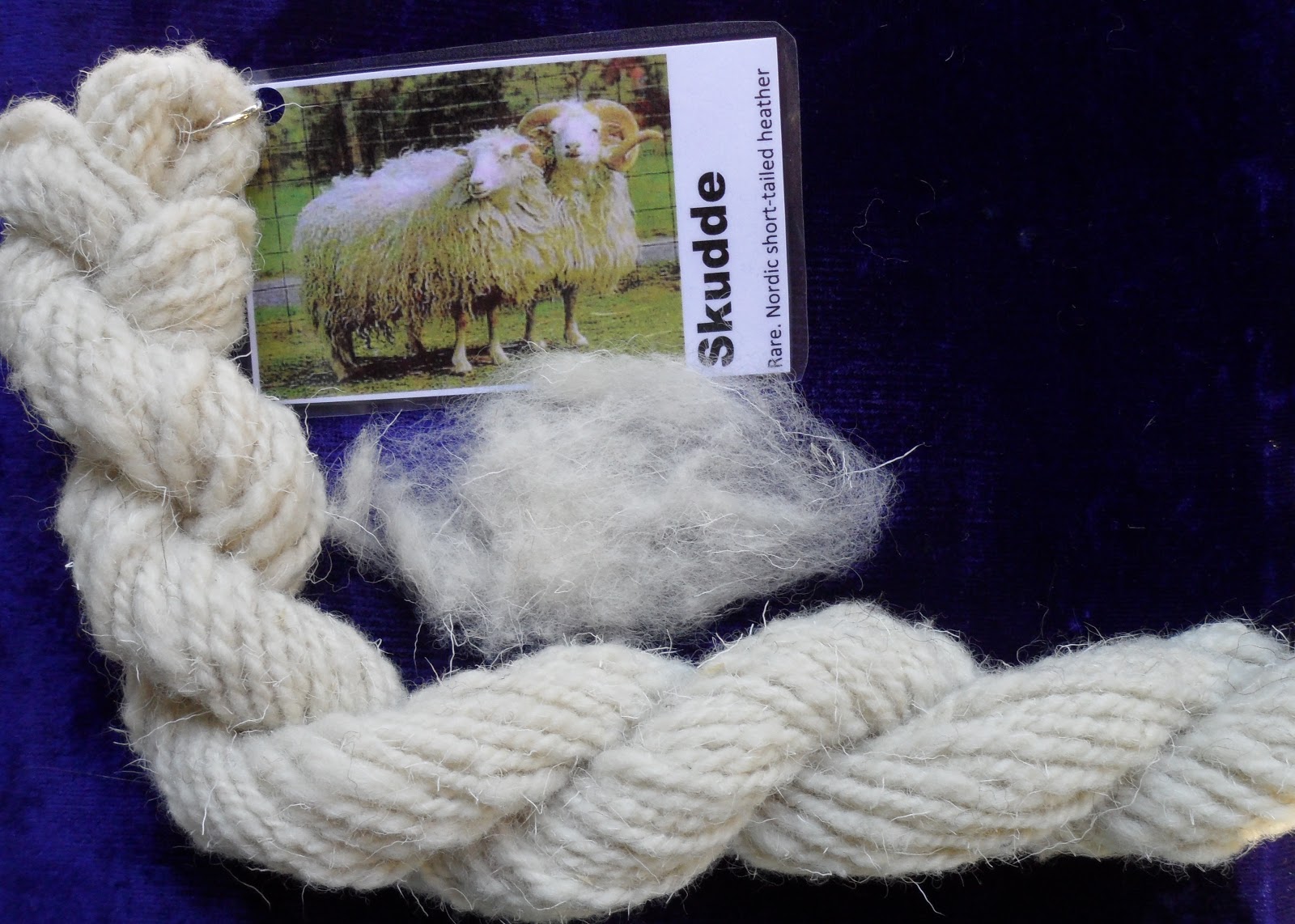
Skudde
Rare breed. Endangered.

About the Skudde Sheep: The Skudde is a Nordic, short-tailed heather sheep belonging to the family of the mischwolligen or heath sheep. Its original homeland was East Prussia and the Baltic States. Evidence suggests it was in existence during the Iron Age and they are possibly direct descendants of the Stone Age sheep. Known as the 'sheep of the Vikings’, they accompanied the Vikings on their travels. The Skudde is culturally important and is also genetically of immense value as they are one of the purest breeds still in existence.

Uses: The wool mixture typical of this breed consists of fine wool fibers, dispersed with short hairs and course cover hair. Traditionally, Skudde would have shed their fleece naturally but this trait has been bred out. The wool was used for rugs and blankets in attractive natural colours. The guard hair is evenly distributed with the wool which makes it appropriate for felting as well as water repelling properties. Shepherds of these flocks always wore hooded cloaks made from Skudde felt. A strong rope can be produced by spinning and plying the wool. Pelts were used for rugs and leather. Males have the snail shaped horns which were used, along with bone for buttons and toggles. The colors are white, brown, black, and gray. White Skuddes have small pigment spots on the head. Although the meat is held to be a delicacy in circles of connoisseurs, for economic reasons (like slow growth rate) they are not kept for their meat. They are suited for pasturing more barren areas where they are indiscriminate in their browsing and foraging habits (like thistles, weeds and other scrub) and are ideal for landscape conservation.

My spinning Experience. Another rare and endangered breed that I have been most fortunate to work with.  Coming to me washed and carded, I didn’t have the opportunity to work with the raw fleece. I did get to experience the fine wool and longer cover hairs which I spun together giving an overall medium coarse spun yarn. Absolutely not next-to-skin-soft for this Princess but would make fine outerwear.

Friday, 15 February 2013

Steinschaf Sheep


Rare Breed

About the Steinschaf Sheep: The Steinschaf is a direct descendent of the now extinct Zaupelschaf or Neolithic Torfschaf making it one of the original breeds of the European Alps.  In the beginning of the 20th century the Steinschaf still roamed the meadows of Bavaria, Germany, especially the areas around Berchtesgaden, Traunstein, and Rosenheim. In Austria, its range was mainly in the Salzburg area.

The original Steinschaf was a dual-coated, small, and wiry high mountain sheep, characteristics making it ideal for the high mountains in the Eastern Alpine regions. The modern Steinschaf is now a robust, small to medium-sized sheep with dual coated fleece with pithy, long coarse hair and fine wavy and short under coat

 With every wool colour from white to black to browns,as well as brindled. They have small heads, free of wool, straight noses and short, pointed ears stuck out sideways. The tail is long and thin. 


According to the Society for the Conservation of old and endangered Livestock Breeds, In 1863 about 208 000 animals existed. Numbers were reduced to 1000 in 1964. Breeders in Germany and Austria collected 30 animals  in 1985 leading to 2004 where they created a programme to market high quality products made of Steinschaf wool. This successfully helped to increase Steinschaf numbers.


My spinning Experience: I was fortunate to have a Steinschaf lamb sample. It was a gorgeous dark, dark shade. A bit neppy, likely through the carding process ,the fibers were short but created a rustic yarn. This Princess recommends spinning a sample of this rare fiber and should you gather enough, it would be an amazing conversation piece(whilst supporting increased Steinschaf numbers) for an outerwear garment…just not next to Princess skin soft.

Monday, 11 February 2013

Tiroler Bergschaf or Tyrolean Mountain Sheep


Staple : my sample approx. 5cm

Micron: unavailable

About Tyrolean Mountain Sheep: date back to ancient Stone Sheep. They are medium to large, pure white without any pigment. They are characterized by long, broad and pendulous (lop) ears. They are found through Austria, Germany, Italy and Switzerland. The Tyrol Mountain originated from Bergamasca, Steinschaf, and Spiegel variety of Carinthian. They are bred primarily for meat .

The wool is quite coarse, thick and oily. The traditional cloth, called Loden was originally woven by peasants living in Loderers in the 16th century . The Sarner Jangger from Valle Sarentino/Sarntal is a tightly-knitted, very warm cardigan and is often worn as part of traditional costume. Typical characteristics are the brightly-coloured seam and antler-horn buttons. Also felted  slippers or Patschen  or Toppar are popular. Fleece from Tiroler Bergschaf /Merino /Jura sheep from the Weiz region provides the outstanding quality to Schladming fabrics and wool products.


My Spinning experience: Of course my spinning experience is limited by my sample. My batt was a bit neppy but after reading more on this fascinating breed, the resulting spun yarn would fit exactly into its current uses. Now whilst my 20g sample will never become one of the amazing garments traditional of the region, this princess would love to slip on a Sarner Jangger and pair of Patschen whilst sitting by the roaring fire of the ski lodge and sip Glühwein.

Wednesday, 30 January 2013

Targhee


Staple; 7.5-12.5cm
Micron 22-25
About Tarhgee sheep: As one of America's youngest breeds having been developed this century, U.S. Sheep Experiment Station, Dubois, Idaho  began breeding  their cross-bred ewes, consisting of Rambouillet, Lincoln, and Corriedale blood with their smoothest, thickest Rambouillet rams  in 1926 . The aim was for a hardy sheep requiring little attention
To fulfill the need to develop a profitable range raised sheep requiring minimal human intervention Many sheep breeders thought the ideal range breed would be ¾ fine wool and ¼ long wool breeding, commonly referred to as a “come back” sheep, referring to  coming back to the Rambouillet . To meet this demand the U.S. Sheep Experiment Station, Dubois, Idaho, began in the fall of 1926 to lay the foundation for such a breed.
The new breed was named Targhee after the National Forest where the animals grazed during the summer. The forest was named for a [1]Chief of the Bannock Indians who had lived in the area in the 1860's.
My spinning Experience: Spinning Targhee was so similar to Cormo which I just recently reviewed. It was fine with a fair amount of elasticity. I just can’t help but compare and reference Cormo, though not quite as soft nor elastic. It is fabulous and I feel that as a garment it would hold up to a bit stronger use and feel wonderful.
My Princess skin rating gives Targhee 4 stars.


[1] Chief Targhee by 1867, was known as, “the great head chief of all the Bannock people.” He led his people through what may have been the most grim period of their history. Admired for his strong character and integrity he was killed while hunting for food by the Crow in the winter of 1871-72.

Tuesday, 22 January 2013

Texel


 Texel: Staple 7.5-15cm
            Micron 26-36

About Texel Sheep: Named after the Island Texel off the Netherlands’ coast. Leicester and Lincoln longwools were crossed with native sheep in the early 19th Century, with meat the primary focus. There are several kinds of Texels including Dutch, English and French. The Texel breed today is a white-faced breed with no wool on the head or legs. The breed is characterized by a distinctive short, wide face with a black nose and widely placed, short ears with a nearly horizontal carriage. These sheep also have black hooves. According to the Oklahoma State University, The Texel has become the dominant terminal-sire breed in Europe. It is currently nearly equal to the Suffolk in market-share in the UK.


My spinning experience:  Not coarse but not real smooth. Let’s commit and say medium. It would make a great workhorse yarn though with that Princess skin of mine again, I would have to put this one on the not next-to-skin-soft list.

My princess skin rating 2 3/4

Sunday, 20 January 2013

The Ingewikkeld repossession of my obsession


Sometimes the easiest things can be the most complicated. Take choosing fiber for the [1]Tour de Fleece. Obviously I wasn’t going to spin it all but historically I spin an abundance of the stash.


Life had thus far been [2]Ingewikkeld and the decision to spin, albeit a frivolous worry was yet another problem to my list. I don’t know. It’s like some irrational notion that if I don’t spin during the TdF, I am somehow a failure. Kinda like the time I felt it important to my character or such to cut sugar from my coffee. And how did that fare you may ask. I did so well at it; I ended up having to quit coffee all together as it gave me heartburn! I wasn’t to know at the time that spinning would be my therapeutic support as our summer was rapidly being sucked into the vortex of an impending storm. A much better outcome than the sugarless coffee for sure.


The wee baggie atop the sheep breed fiber bag resembled the eye of a storm. I grabbed hold. I spun that 20g. I grabbed another. I grabbed 2 that day. I grabbed 3 the next.


I worked. I took my husband to and from the hospital. I cleaned. I cooked. I spun. I spun 47 breeds of sheep. I even processed my first raw fleece.

Joe's brother Frans passed away with his adorable wife, Elise by his side 32 days from his cancer diagnosis.
Frans(left) and Joe at our wedding 2002
 

Yes, a lot happened [3]that summer (Oh yeah, there's more to come). Not only caught up in all the drama of my life, I was over thinking things. What stalled my blogging was the indecision to share just the sheep breeds or more. I mean, if anyone is reading my blog, would they want to hear the drama of my life or just want to skip to the facts of this mammoth sheep breed spintastic project of mine? In the end, it is [4]just a blog. It's a blog about spinning but behind that, it's a blog about my experiences spinning. Summer spinning has been cathartic, an unexpected therapy. It literally held me together over my summer so please enjoy now as I share further, all the breeds of sheep that did and will cross my path and perhaps a few more crazy insights into what I call my life.


[1] A fun competition on Ravelry comprising of teams, mostly with funny names and self-challenges which coincidentally coincides with the Tour de Fleece. Think of it as we spin, they spin.
 
[2] Ingewikkeld. Complicated according to my Dutch husband's mother who apparently said this often. Heck, she should know. She had 18 children!
 
[3] My summer really identified with my favourite manically depressed robot, Marvin: The first ten million years were the worst. And the second ten million: they were the worst, too. The third ten million I didn't enjoy at all. After that, I went into a bit of a decline.
[4] Poke me with an orifice hook should I say “It is what it is” ::Gag!::

Tuesday, 1 January 2013

Cheingora


I just want to take a little side trip into Cheingora, or dog hair. For your first experiment with dog hair, I can’t recommend fervently enough to have someone else prepare your fiber far, far away from your home. If you have ever tried to card angora, you will know it’s not for the faint of heart. There are also preferred methods of collection of which you would know me well enough by now to know that would not be how I did it. Our groomer bathed our Bichon and then cut his hair. Sounded so good to me. Apparently for best results, unwashed and brushed out/shed hair is best (except Bichons don’t shed). Not to worry. I have a big bag of hair I may again attempt to card once the memory of the flying fur feeble first attempt fade from my mind.

I ordered some Sami (Samoyed/Shetland) roving from Mountain Fiber Folk Cooperative in Vermont and happily set to work. Surely no one expected me to give up on spinning dog hair, really? I keep my recent handspun skeins in a bowl on the coffee table for

1.      Inspiration to work with it

2.      Decide to keep it or not

3.      Admire, pet it and call it George

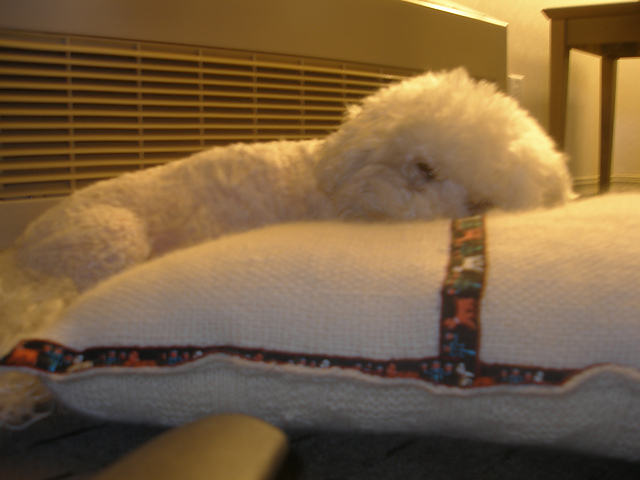
10pm every night, Jake has what is commonly referred to as the Bichon Blitz. We tuck in our heads, hold on to our wine as Jake tosses and hurls toys flying and then tears circuits around the coffee table. This one night, he jumped up to the bowl of handspun beauteousness and snatches Sami, eloping to his couch. Jake has never taken to any of my fiber or yarn before. I stop at mentioning finished shawls as he is a little prince after his mother. The softer and finer the knitting. the happier he is to sleep on it.

Jake had become obsessed with Sami. Everyone suggested I make something for him from the yarn.  The opportunity arose with the annual guild challenge, this year to be to make a pillow. I would knit a pillow for Jake from Sami.


On Ravelry, I came across alphabet pattern dish cloth designs and resolved to knit patchwork squares with his name.

Oops. 1 square short, I have run out of yarn. Speaking of running. This is where stories intersect. This is the time of the black water escape and this is the project that escaped with us.

So…the coop was out of fiber but Christy on Ravelry kindly offered me her handspun which just happened to arrive in time for me to grab it (and the ½ bottle of wine) and head out through our condemned door


Phew! Problem solved yarn wise. The condo not so much


note the different colour in the bottom right and far middle left
as indicated by Jake
Now I want to add something interesting in an educational way. Both Christy and I had the exact same roving. We even ended up with very similar weight yarn but that is where the similarity ends. They could have been 2 totally different fibers for how different they looked. Hers was white, bloomed and fluffy and mine more of a golden sandy, smoother yarn. According to Judith Mackenzie, yarns spun differently from the same fiber can appear to be totally different colours. Huh!


But wait. Christy sent 2 skeins! I think I have enough yarn to weave the second side of the pillow.


We brave the condo construction and retrieve my rigid heddle loom (we won’t linger long here). Much maths later, the loom is warped up and off I go.

Oops, I’m out of yarn! What was Christy thinking sending me 2 skein s? The woman who created this fiber who also happens to have a dog called Jake is sending me a wee skein but my deadline looms near and my condo looms far…Canada post, even further.

I can still make it work. I buy some doggy braid, Velcro and set to reinforcing the woven fabric to cut it up and patchwork it with the braid.

I borrow the work sewing machine. It doesn’t go

I brave the condo construction for my machine. It goes but it won’t bloody stop.

My summer is not progressing so well.

 Take myself to friend Agnes’ house and sewing machine. I immediately break the needle.  Am feeling like Marvin in the Hitchhikers Guide to the Galaxy but I am not having any sort of conversation with these machines, let alone an intelligent one.

New needle loaded, we get this pillow done and dusted with a day to spare before presentation

…A few days later, a parcel arrives in the mail. SAMMI handspun yarn from Sabra and Mountain Fiber Folk Cooperative. Oh no. A doggie fisherman sweater perhaps. I wonder if I have enough…
A truly fiber obsessed canine