Showing posts with label Border leicester. Show all posts

Sunday, 9 September 2012

Chee-vee-iot, chee-vee-iot, chee-vee-iot!


Cheviot

Staple: 10-15cm

Micron 24-33

About Cheviot sheep :pronounced Chee-vee-iot) there appears no reliable information further than that sheep were in 1372 "a small, but very hardy race over large tracts of the Cheviot Hills". Originally there were 3 types within the breed being Border Cheviot or South Country Cheviot, [1]Brecknock Hill Cheviot (from Wales) and North Country Cheviot (from Scotland). The Cheviot Sheep Society was formed in 1890 and is one of the oldest sheep societies in existence. They are used a lot in breeding including Canadian Arcott, Montdale, Border Leicester, Rygja, Steigar and Perendale. They blend extremely well with other breeds.

The wool has a unique 3D crimp.

My princess skin rating 3 stars
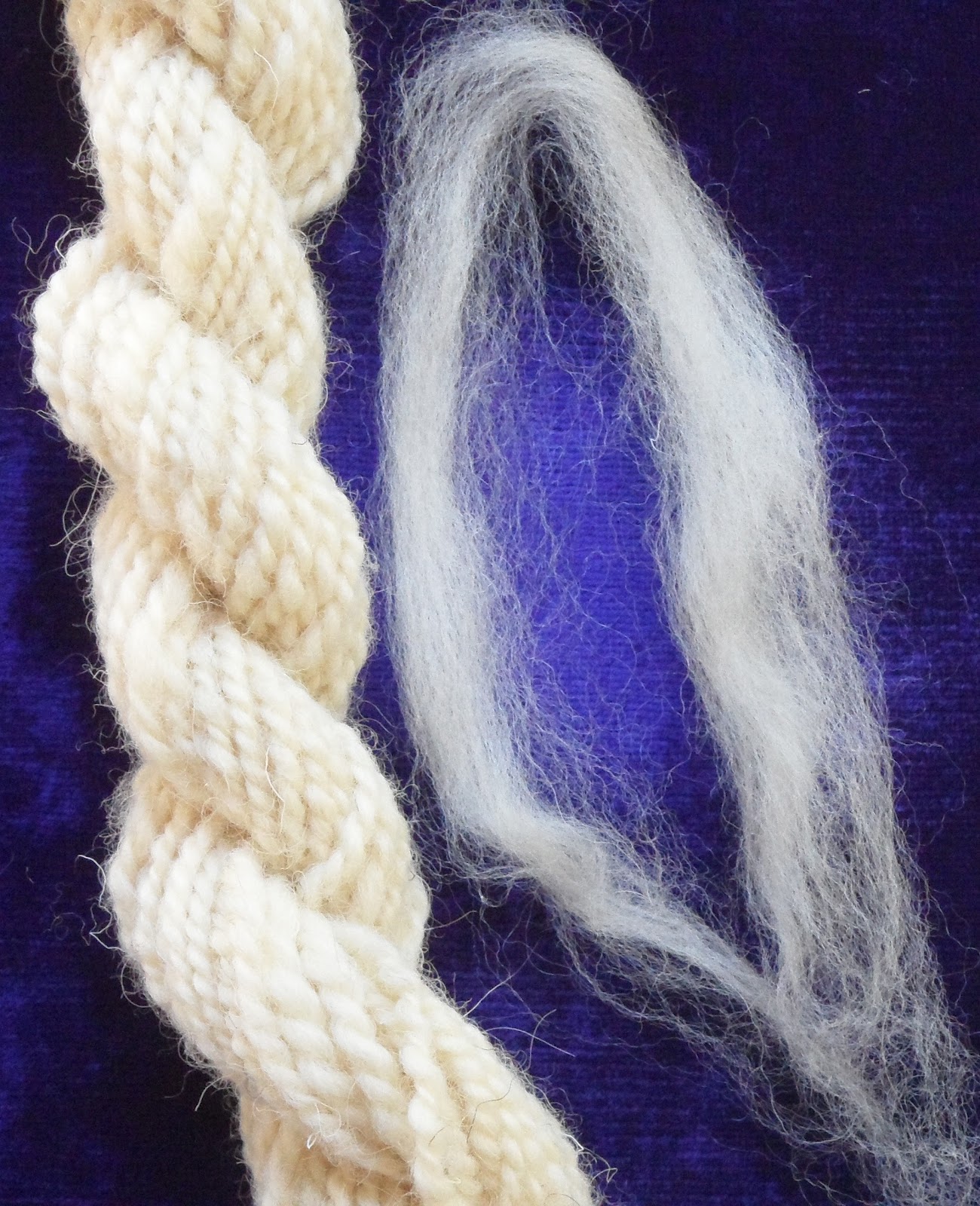
My Spinning experience: my sample was an easy spin from a flicked open lock. The resulting yarn was medium in coarseness with next to skin wear ability. Apparently it is a fabulous yarn for socks. Cheviot fiber blends well with other fibers. I currently have some pretty Cheviot/Tussah Silk on my wheel. At spin night the other week I was asked about my fiber by my fellow spinners.  Cheviot (pronouncing She-vee-ot) I replied. Pauline commented how she always thought it Chee-vee-iot. Now Pauline’s from the UK so she may just be on to something with the rest of the group hailing from Australia, Germany, Norway and Canada. I took to the internet, specifically Ravelry when I got home and posed the very same question. Just how do you pronounce Cheviot? Aj from Fair Isle weighed in with chee is correct, pronounce it shee and English breed society will look at you in alarm. That was enough to implant a Chee-vee-it earworm which sadly enough is back after writing this article. Chee-vee-it, chee-vee-it, chee-vee-it…as I run screaming from the room.


[1] Now known as Miniature Cheviot Sheep in the USA

Tuesday, 28 August 2012

My first, firstly, and foremost fiber...Coopworth


My next group spin I appear to have my hand caught in the “C” basket. Coopworth, CVM, Corriedale, Cotswold, Cheviot and Cormo! Again my unreliable memoirs bother me as my calendar tells me this was a Saturday. I am starting to suspect I may have been home sick from work and bored out of my gourd. My usual activity when I am at home sick is to paint. Not pretty pictures, but our condominium. I have even had to email pictures of the condo to my husband at work else he goes into the wrong home. One of his favourite stories was when I had bronchitis and he goes to work as usual, only to come home to find the bedroom no longer a mind numbing magnolia but a fun, vibrant bright orange! So fiber addled brain aside, my next spin is Coopworth.

Coopworth

Micron 30-39

Staple 2.5-20.5

About Coopworth: They were developed in New Zealand in the 1950’s using Romney and Border Leicester led by college professor, Ian Coop at Lincoln College in Canterbury NZ. The breed and name was adopted in 1963..a memorable year. JFK left the world and I entered!
Coopworth fleece differ depending on geographic location but they all have defined crimp, luster and long staple fleece.


My spinning experience: Coopworth is a very easy spin. It was actually the first fiber I ever spun. Heck, I made yarn on my first lesson so it must be an easy spin! It spins easily form lock and is not dense of grease. Books decry Coopworth's next to skin softness. I'm a bit of a Princess where fiber softness goes and my sample whereas not super soft would be just fine for a sweater, scarf, gloves etc.  My first skein of Coopworth however is just perfectly suited to be on display and nowhere near my porcelain Princess skin.
Coopworth: My first fiber. My first ever skein of yarn

Friday, 24 August 2012

Gummy bears and fluffy sheep


Taste, test, try....
Whereas all brands of gummy bears are not created equal, the same can be said of fleece within a breed. Even with certain breeds like Cormo and BFL where fleece is very consistent within the breed, there are also other variables, in particular from shearing and processing. We all dream of a clean first cut from a coated sheep but may come across [1]vegetable matter, [2]second cuts, fibers that break easily and chemically over processing which results in dry, crisp and [3]neps.


As you delve into the different breeds, you will find a relatively small number available as commercially processed top and rovings. As you go even further into the more rare and endangered sheep, you will pretty much take what you can get. I should mention now if anyone feels so inclined to send me a Saxon Merino fleece, I’ll help you out and pick up the shipping. Hey, least I can do.


But what really is my point here or have I lost the plot of this post? What I want to say is, I have gotten some really shitty samples but don’t want to discount the whole breed because of 20g. Instead I’ll add it to my try-it-again list but from a different source if possible. Same goes for a fiber that I absolutely love and trust me, read on. There will be many. I want to try that breed again, perhaps in lock if I had spun roving,  before I go committing to a whole fleece…unless the aforementioned Saxon.


Border Leicester
Longwool

Staple: 10-25.5(Half that if shorn 2x year)
 
Micron: depending on country but

              ranges 29.25(UK)-40(NZ)


About Border Leicester Sheep: Are in direct lineage to the 1767 Dishley Leicester (now extinct).By 1789 there were two distinct types of “Dishley Leicester” evolving in the English border counties. One flock was being crossed with Teeswater (nicknamed Bluecaps) and another on the other border, crossed with Cheviot (nicknamed Redlegs). The Border farmers preferred the hardier redlegs and by about 1850 this variation of the “Dishley Leicester” became known as Border Leicester

 
My spinning experience:  with slightly less slick fibers than the BFL, this is an easier manageable spin with slightly less luster. The yarn would provide lovely stitch definition. Locks (which I spun for my sample) were long and lustrous, perfect for dyeing or art yarn tail spinning. This was an easy, enjoyable spin.


[1] Vegetation, amongst other things caught up in the fleece
[2] Where the shearer cuts an already cut fiber. If not removed, they can cause pilling in the resulting yarn/garment
[3] Little annoying balls that drive you bonkers picking them out of fiber that can be caused by incorrect  carding, second cuts